
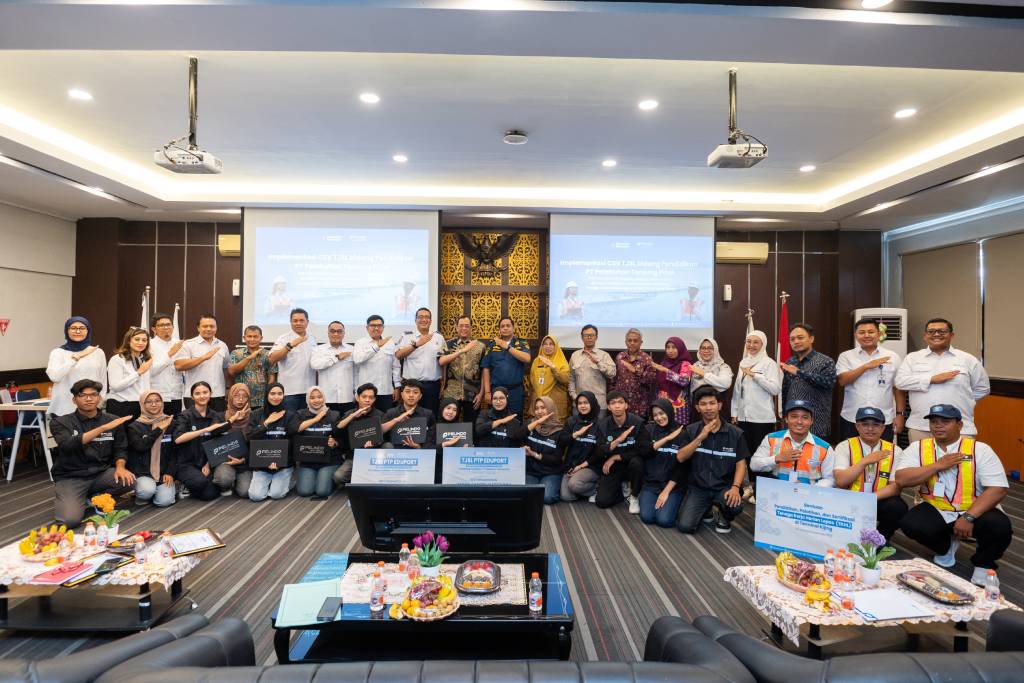
Kijing, 24 November 2025 — Terminal Kijing, located in Mempawah Regency, West Kalimantan, and operated by PT Pelabuhan Tanjung Priok (PTP Nonpetikemas) Pontianak Branch, has become the center of a Creating Shared Value (CSV)-based Social and Environmental Responsibility (TJSL) program. The initiative strengthens port operations while empowering communities through education, student innovation, and certification for daily workers.
The event, held on Monday, 24 November 2025, was attended by Pelindo Group management, local government representatives, port authorities, and academic institutions. Their presence underscored the importance of synergy between industry, education, and local communities in building a learning ecosystem and fostering empowerment at Terminal Kijing.
Through the EduPort Program, 15 students from Universitas Tanjungpura and Universitas Muhammadiyah Pontianak participated in a one-month structured internship, field learning, and the development of innovation proposals tailored to port operational needs. Following presentations and evaluation, five innovations were selected as the best in the categories of Best Out of the Box Idea, Best Work Safety, Best Environmental Health, Best Engineering Structure, and Best Operations Solution. Two proposals—Oil Absorb Pad and Rubber Mat Puzzle—are targeted for implementation by the end of 2025.
PTP Nonpetikemas Director of Finance, HR, and Risk Management, Bambang Sakti, emphasized:
“These innovations don’t stop here. Two programs are targeted for implementation in 2025, and the remaining three in 2026. We are proud that this social investment strengthens relationships, benefits the business, and motivates our daily workers. This CSV-based TJSL initiative also brings together communities and students, ensuring that the impact extends beyond the company to workforce development and the logistics ecosystem surrounding Terminal Kijing.”
He added that this program demonstrates that ports function not only as logistics hubs but also as learning ecosystems.
“Input from students and universities provides new perspectives for improving efficiency, HSSE, and operational excellence. Additionally, the training and certification of daily workers is a strategic step toward preparing skilled local labor with national standards, particularly in the handling of liquid bulk, dry bulk, and general cargo,” Bambang explained.
At the same event, the General Manager of Pelindo Regional 2 Pontianak—represented by Business Compliance Manager Mustafa—commended PTP Nonpetikemas for uniting industry, academia, and local communities through the EduPort program and daily worker certification. He noted that the initiative demonstrates Pelindo Group’s commitment to developing high-quality human resources in its operational regions. Mustafa also highlighted Terminal Kijing’s strategic importance as one of the key supply chain backbones in western Indonesia, especially with its strong potential as an export gateway for palm oil derivative products, supported by West Kalimantan’s extensive palm oil industry ecosystem.
Local government support also followed suit. Head of the Mempawah Regency Office of Industry and Manpower, Johana Sari Margiani, stated that the program aligns with the Indonesia Emas vision by expanding student learning access and accelerating the availability of competent workers ready to enter the industry. She noted that PTP Nonpetikemas serves as an inspiration for other companies.
Additional appreciation came from the Class I Port Authority and Harbormaster Office (KSOP) Pontianak, represented by Heriansyah from the Marine Division, acknowledging the program’s benefits for port operations and its contribution to sustainable human resource development.
One EduPort participant, Muhammad Afiq, shared that he and his peers initially did not expect to be selected and felt unsure, but were grateful for the opportunity. They explained that their first task at PTP Nonpetikemas was to finalize their scientific innovation proposals, hoping that their ideas could be effectively applied to support Terminal Kijing’s operations.
Beyond student innovation, PTP Nonpetikemas also implemented the Daily Worker Certification and Training Program. A total of nine daily workers completed the initial training and earned certification from the National Professional Certification Agency (BNSP) in the handling of Liquid Bulk, Dry Bulk, and General Cargo. This program ensures that daily workers possess the required competencies to support port services professionally.
The implementation of PTP Nonpetikemas’ CSV-based education initiatives not only supports community human resource development but also strengthens operational sustainability for the company.
With the completion of the EduPort Program and the launch of the Daily Worker Training initiative, PTP Nonpetikemas aims to replicate this collaboration model at other branches to broaden its social impact and deliver lasting value to both communities and the company.
Terminal Kijing currently handles key commodities including liquid bulk, dry bulk, and palm oil derivative products. The terminal also functions as a buffer port supporting Dwikora Port Pontianak, which has exceeded its capacity.
As of October 2025, PTP Nonpetikemas Pontianak Branch recorded 3.21 million tons of production traffic—an impressive 46% increase compared with the same period in 2024, which reached 2.2 million tons.
With this strategic role, Terminal Kijing continues to serve as a vital logistics solution, supporting the smooth flow of the national supply chain while enhancing Indonesia’s competitiveness in the port sector.